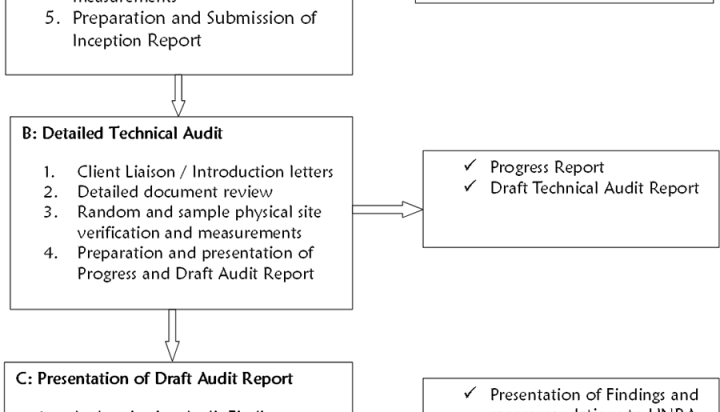
Figure 1: Graphic illustration of Activities and Deliverables


Technical Audit Projects
SCOPE OF CONSULTING SERVICES
The scope of our consultation shall mainly be categorized in the activities namely as Project Familiarization, Initial Audit and Annual Audits, which are as further explained in the sub-sections below:
- Project Familiarization
Under this stage the Technical Auditor shall:
- The Technical Auditor carry out this stage immediately after been appointed and within two weeks of award of the civil works contract;
- The Technical Auditor will clearly understand the scope and complexities of the project by reviewing all financing agreement documents, all contracts’ documentation including drawings, specifications, materials reports and conditions of contract;
- Study the tender documents and price submitted by the Contractor related to the Contractors proposed programme as well as his resources. The Auditor will require consultation with the CLIENTS;
- visit the project site during this phase to acquaint himself with the ground conditions;
- prepare and submit a report on project familiarization to the CLIENTS highlighting this outcome as part of the Inception report;
- Initial Audit
- The Consultant will focus on assessing the progress of the initial activities of the project.
- A report on the initial audit should be submitted to the CLIENTS highlighting this outcome as part of the Initial Audit Report;
- Annual Audits
The Technical Auditor shall:
- carry out an Annual Audits, every 12 months, to verify the quality, quantity, and delivery of all the Contracts (both Civil Works and Services) to ensure that they are consistent with their project procedures and processes, with the Contract Conditions as well as the technical specifications, including the management of environmental and social safeguards;
- start with a review of the previous Audits that is the Initial Audit (or the previous Intermediate Audit) to follow up on the subsequent actions carried out by CLIENTS, the Consultants and the Contractors in response to the recommendations made by the previous Audit.
- Submit a report on the Intermediate Audit to the CLIENTS and the Financiers highlighting this outcome as part of the Intermediate Audit Report.
- Compliance with the agreed works programme
The Technical Auditor shall carry out compliance checks of the works and services programmes to ensure that the Project schedule is aligned with Project targets in terms of cost and time. The audit shall include, but not be limited to, the following:
- Review the Project to ensure compliance with the agreed work program;
- Verify that the Project is being executed is accordance with the work plan;
- Verify that the costing of each work plan item is consistent with the unit cost developed;
- Verify that the material quantities are satisfactorily measured and recorded.
- Quality of the works
The Technical Auditor shall carry out inspection of the works to ensure and verify the quality of the works is in compliance with the approved design and technical specifications.
- Quality of Works methodology:
On this part, to complement TORs the audit verifies that the methodology adopted in the implementation of the works are in a manner that assure the quality of the works. The Technical Auditor and the Audit to be done shall include, but not be limited to, the following:
- Carry out random inspection, on representative samples of Supplier/Contractor’s plant and equipment and verify that the minimum equipment and manpower stipulated under the contract is provided and maintained in suitable quantities and condition;
- Carry out random assessment on the competence of key site personnel of Contractor and the Supervision Consultant;
- Verify works methodology is in accordance with the contract and good working practice;
- Verify safety conditions of site with respect to specified warning signs and personnel behaviors on the site; and
- Verify that works are being implemented in compliance with environmental and social impact mitigation measures;
- Quality of the ROW Land Acquisition and RAP Implementation
The Scope on this part will involve the technical auditor to examine and assess whether CLIENTS is acquiring the ROW and resettling the project affected persons in accordance with the Environmental and Social Commitment Plan (ESCP), with the agreed and disclosed RAP, and in any accordance with any statutory laws and regulations. The Technical Auditor will examine and assess whether the complimentary initiatives were incorporated in the project designs.
- Quality of the Environmental and Social Management
Under this scope the Technical auditor will:
- examine and assess whether CLIENTS and the Contractor are implementing the Environmental and Social Management Plan in according with the Environmental and Social Commitment Plan (ESCP), and the Financing Agreement;
- review the ESCP implementation in line with commitment and the deadline;
- assess the efficiency of the E&S team at the PIU, the Civil engineer and Contractor;
- examine and assess whether the contractor has prepared a Contractor Environmental and Social Management Plan (CESMP) linking environmental and social activities for the road works in line with ESMP developed during the studies and guidance issued by CLIENTS in accordance with the Financing Agreement.
- assess the effectiveness and adequacy of the Environmental and Social Management mitigation measures as specified with in the ESMP.
- Financial
Under this part of scope the Technical Auditor will examine and assess the correctness of the financial statements, payment certificates (including requests for advance payments) issued by the Works Contractors and the Consultants on the project. The Technical Auditor will check or verify that:
- all payments to the Contractor (and other Consultants) are being made as per the Contract Conditions;
- there is sufficient approval of any price variations and adjustments;
- the management of the expenditure and their accounting under the appropriate;
- measurement records are carried out in accordance with Contract leading to any latest payment certificates, and;
- any disputes and claims are being dealt with in line with the Conditions of Contract;
- verify that the claimed quantities are the actual work done.
The Auditor will examine and assess the correctness of the invoices issued by the Consultants in accordance with their Contract. The auditor should focus on verifying that the Consultant’s services (for which payment is being sought) were performed.
- Monitoring and Evaluation
The Technical Auditor will provide in his reports if so agreed with the client chapters covering on the continual monitoring and evaluation of the performance of the project and recommending improvement.
- Field Visits
During the implementation of the works, the Technical Audit Consultants will make field visits as an integral part of a continuous technical audit process to witness the works. The number of field visits and their timing should be planned in such a way that the Auditors will be able to prepare audit report as described in the reporting section.
- Provide advisory services to CLIENTS
On this part of scope the Consultant shall:
- provide advisory services to CLIENTS on quality and quantity assurance and Contract Management for Works and Services specific to the project. The recommendations shall be included as they become available;
- review the formats/guidelines as being used by the Contractor, Supervision Consultant, and other Consultants on Environmental and Social Safeguards, their proposed methodology and Work program for each Contract as included in the Project and recommend any modifications if any;
- prescribe suitable formats for progress reporting existing or as is being used by stakeholders.
- Final Audit
The Technical Auditor shall:
- commence the preparation of the final report at least four weeks before the conclusion of the Project. The purpose of the final audit is to validate and confirm that the project has been carried out in accordance with the specified procedures and processes, specifications, etc., and that the project outcomes have been achieved as originally planned.
- Submit the report of final audit to the CLIENTS highlighting outcome as part of the Final Audit Report.
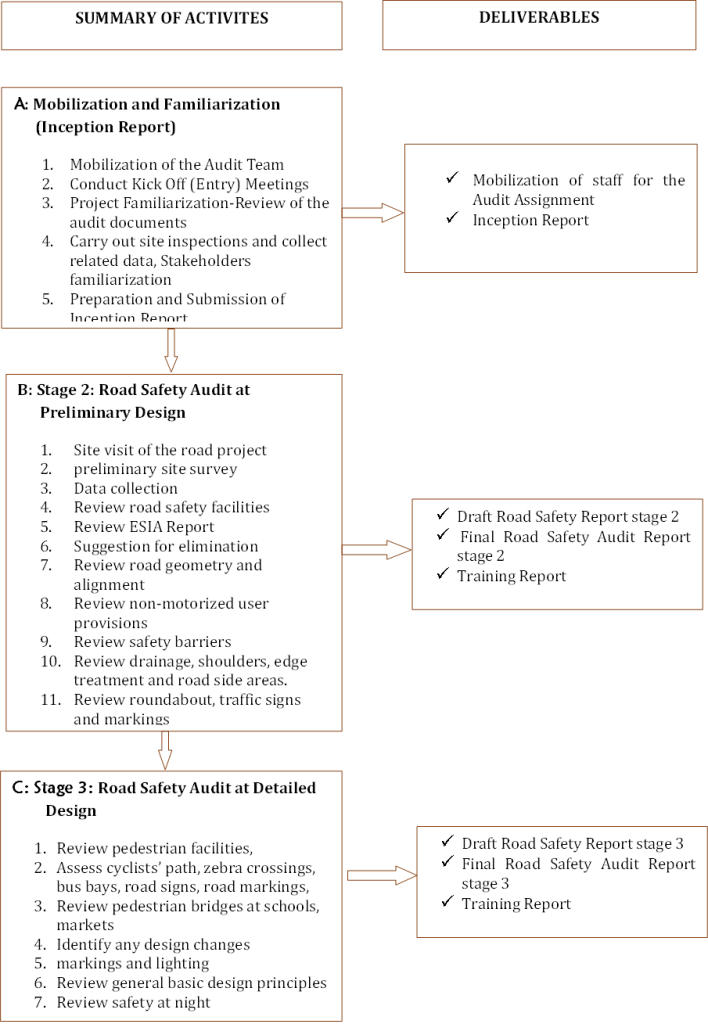
Flow chart for Road Safety Audit undertakings
Figure 2: Graphic illustration of Activities and Deliverables
ROAD SAFETY AUDIT
Countries are generally geographically small to large, diverse and strategically important depending on development strategies of various countries. Road crash incidence in Countries usually ranks top especially in African Countries, after HIV/AIDS and Malaria and has notable economic and social impact in the country.
The road safety situation in Countries is among the worst in many countries especially in Sub-Sahara Africa. Crashes are known to increase on newly constructed roads, this is due to the fact that vehicles travel at higher speeds as a result of the improved riding quality thereby increasing the likelihood of accidents. Furthermore, new roads attract increase in the number of vehicles and people movements which increase the risk of road catastrophes.
In terms of urbanization growth, many Countries show expeditious urbanization. Furthermore, population keeps growing fast, adding million people annually both in rural and Urban areas, which poses pressure on the economy, transport infrastructure, urban planning, job creation, etc. Road accessibility is one of the necessary conditions for inclusion and socioeconomic opportunities and as a result, the design criteria often neglect important day-to-day road-users, such as pupils walking to school, patients trying to get to the hospital, or farmers transporting goods on bicycles and motorbikes. Together, these groups and other not using cars or lorries represent the majority of rural road-users and the primary stakeholders of Countries’ economies. They are also the ones at greatest risk of falling victim of a vehicle design philosophy that did not sufficiently cater for their needs and safety. Thus, vulnerable road-users are the most impacted on both high and low volume roads in both Urban and rural areas. As such, a focus on people should not be an afterthought in road design, but a core principle. This is where the Road safety must come in to address related challenges with the objective to improve both Urban and rural road access for population in various projects and build capacity in the sustainable management incorporating community engagement approaches. With various program, Countries may rollout road development ensuring that Trunk roads, regional and district roads are designed with a participatory philosophy that caters for all road-users. As such, roads to be improved through various Project initiatives, must be designed to engage users, include and protect both Urban and rural communities.
Road Safety Audits shall generally be in compliance to the requirements of the Terms of Reference (TOR) and to supplement more. In each of the Audit stages and the Audit in general, further references shall be made to the “A Guide to Road Safety Auditing, as being used by the Client. Other references in best practice as applicable and acceptable by the Client will equally be referred so as to improve and realize quality ending Audit to the Client. With this project scope, there will generally be two stages of Audit namely Stage 2- Preliminary design stage (RSA Stage 2) and Detailed Design stage (RSA Stage 3). The Specific Tasks and activities shall be highlighted as generally provided in the TORs by the Clients.
The Audit stages may change depending on the Client’s TORs.